
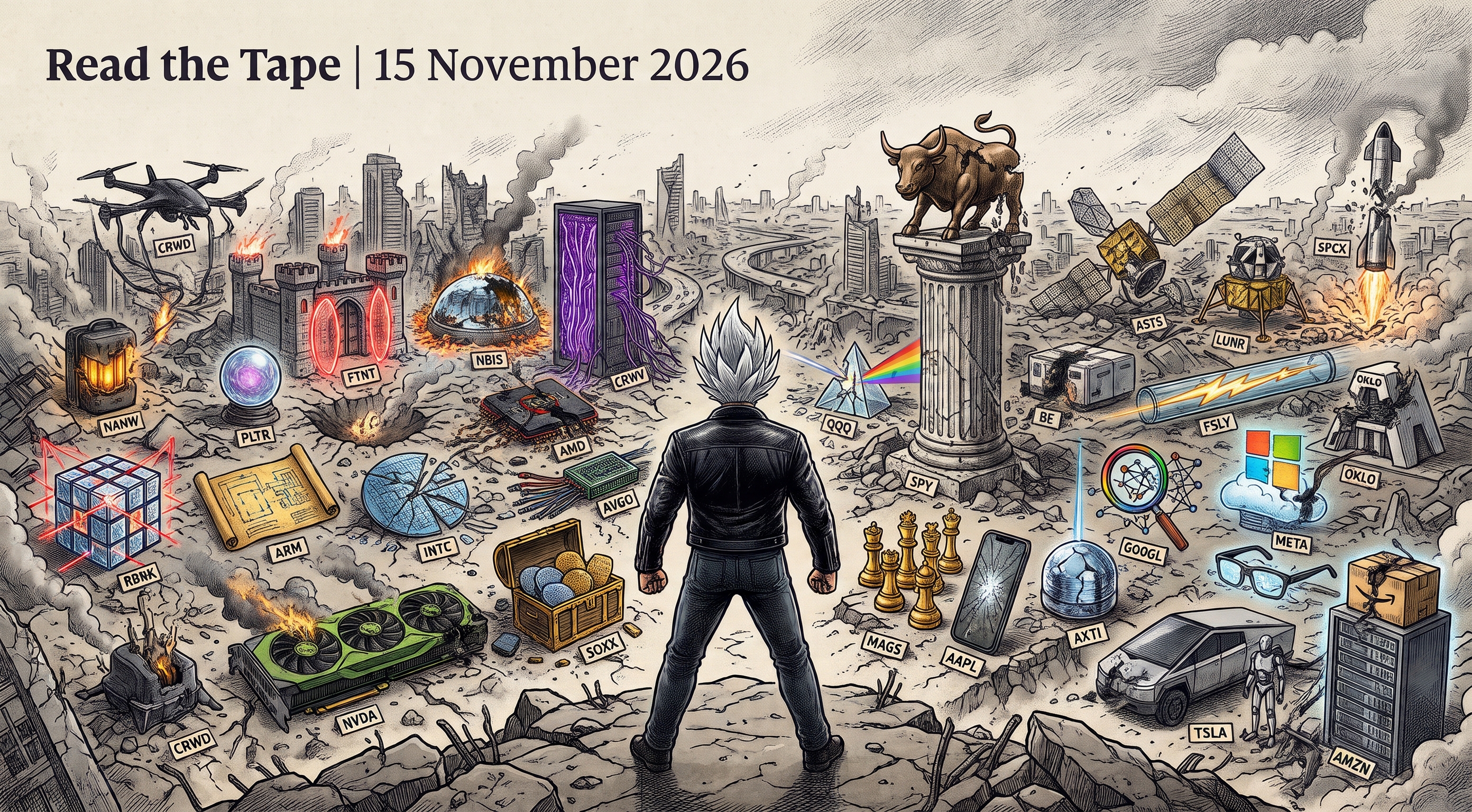
The market has likely completed its rebound that began on 6 November (Friday). While the bounce was strong, it was unsurprisingly short-lived. We anticipate the market will again enter a choppy, trendless period, which calls for lowering risk exposures.


Nvidia – bottom-fishing opportunity?
The volatility surrounding Nvidia has been fierce, but it did provide a short-term opportunity on an extreme reversal last Thursday (12 November) when ex-CEO Jensen Huang tendered his resignation. At market open, Nvidia was down roughly 13%, but it recovered throughout the day to close down just 4%. Rather than representing a fundamental resolution of Nvidia’s struggles, we think this bounce was primarily driven by short-covering and the unwinding of a popular pair trade (long-AMD / short-Nvidia) over the past week.

Nvidia’s strategy and identity have been heavily shaped by Jensen Huang; his leadership and technical expertise single-handedly brought the company to the global stage. Consequently, his departure introduces massive uncertainty regarding Nvidia’s future path, leaving little fundamental justification for bottom-fishing at current level. In fact, a potential return of Jensen Huang should not be entirely ruled out, especially given the overwhelming support from investors and employees, making aggressive short bets risky. We have seen similar dramatic founder/leader reinstatements before, with Sam Altman’s brief exit and return to OpenAI being a prime example.
Implications for wider AI infrastructure
There are also broader implications for the wider AI infrastructure ecosystem. Consider memory as an example: Nvidia has historically released new chips annually, demanding significantly higher memory requirements with each generation. This rapid release cycle has forced hyperscalers to consistently upgrade their HBM (High Bandwidth Memory) and increase their NAND exposure to cope with enhanced capacity. The departure of such a pivotal CEO will likely usher in a period of stagnation in strategy, product development, and execution. This deceleration will also weigh on the pace of industry capex and could trigger a reshuffling of TSMC capacity allocation among semiconductor manufacturers. That said, rivals such as AMD, Broadcom, and Intel could benefit from potential market share gains as hyperscalers diversify their compute supply.

Sector Rotation: Tech Leadership Fades as Defensive Value Outperforms
During this latest cycle of correction and rebound, former segments with relative strength, such as cybersecurity and biotech, have suffered steep sell-offs and staged only modest recoveries.
- Isolated Tech Outliers vs. Broad AI Weakness: One notable exception has been pure-play chipmaker AMD, which surged 45% in the week leading up to Thursday, 11 November, largely capitalizing on the fallout surrounding its primary GPU rival. Aside from isolated pair-trade beneficiaries, however, no clear leadership group has emerged within the broader AI infrastructure space during this recovery.

- Rotation into Financials and Consumer Names: In general, non-tech sectors have demonstrated significantly better relative strength. Financials and consumer discretionary stocks have been particularly resilient of late, with notable outperformance across financials, such as XLF, and consumer names including VFC, AEO, COLM, VSXY (or VSCO), and COKE.


Given the lack of durable leading stocks and narrowing market breadth, we remain cautious in the current environment and reiterate our view: less is more.
The information provided in this note is for educational and informational purposes only and does not constitute financial, investment, or professional advice.

Leave a Reply